










ESCO-TDS600 IR H2 Thermal Desorption Hydrogen Analyzer
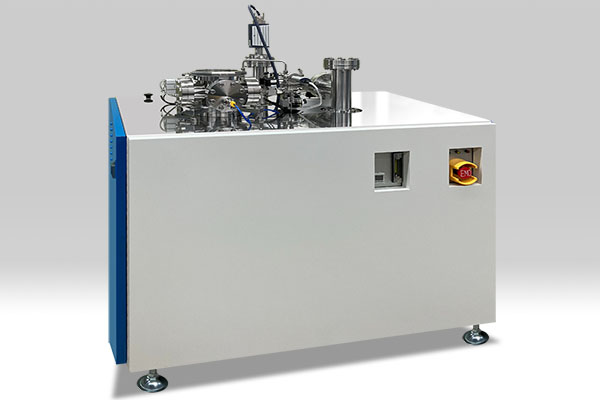 Temperature-Programmed Desorption Hydrogen Analyzer ESCO-TDS600 IR H2
The ESCO-TDS600 IR H2 Thermal Desorption Hydrogen Analyzer
The ESCO-TDS600 IR H2 Thermal Desorption Hydrogen Analyzer is equipped with a highly sensitive mass spectrometer and accurately measures trace amounts of hydrogen at the ppb level released from metal materials and plating films.
Although this instrument uses a mass spectrometer (vacuum type), it offers simple operation that even beginners can handle—simply close the lid and press the start button.
From new material development to quality control on the manufacturing floor, we strongly support next-generation manufacturing by converting the risk of invisible “creep failure” into reliable quantitative data.

 Image of an automotive frame
“Diffusible hydrogen”—just a few ppb—that threatens high-strength materials
“Diffusible hydrogen”—which moves within metals—is attracting attention as a factor causing sudden fracture (delayed fracture) in steel materials such as ultra-high-strength steel, and its presence at levels as low as a few ppb significantly threatens material reliability.
International standards for hydrogen measurement, such as ISO 3690 and AWS A4.3, are widely used in material safety evaluations.
However, the failure phenomena caused by hydrogen are extremely complex. As materials become stronger and operating environments more severe, cases are emerging in cutting-edge R&D and manufacturing settings where basic evaluations based on standards alone cannot fully explain the subtle delayed fracture behavior observed in actual tensile tests.
To ensure a higher level of safety, it is necessary to immediately and precisely identify, at the ppb level, diffusive hydrogen and more strongly trapped hydrogen—which are direct factors in delayed fracture—right on the production floor. This device powerfully complements the highly reliable evaluation system based on international standards and provides insights that take a step further toward new manufacturing approaches.
The Dilemma of Choosing an Analytical Instrument
Traditionally, “mass spectrometry” offered high precision but was expensive compared to “gas chromatography,” while “gas chromatography” suffered from relatively lower precision (or is it sensitivity?).
The ESCO-TDS600 IR H2 is a groundbreaking instrument that solves these challenges.
While maintaining high sensitivity and excellent quantitation, its unique design achieves superior operability and low initial costs despite being an ultra-high vacuum instrument.
| Comparison Criteria | ESCO-TDS600 IR H2 (Electron Science) | Gas Chromatography (Atmospheric Pressure Type) |
|---|---|---|
| Analysis Method | Ultra-high vacuum mass spectrometer | Atmospheric pressure gas chromatograph |
| Measurement Sensitivity and Quantitativeness | ○High (No side reactions; ppb level) | △Concerns (Risk of side reactions) |
| Ease of Operation | ◎ Easy (Just place sample and press button) |
◎ Easy (No vacuum chamber required) |
| Data Acquisition Speed | ◎High Speed (Once per second) |
△ (About once every few minutes) |
| Position | Combines the high sensitivity and accuracy of mass spectrometry with the ease of use of gas chromatography | Easy to use |
A practical model that enables rapid pass/fail determination from the laboratory to the “manufacturing floor”
Compared to the high-end model of the ESCO-TDS series, the ESCO-TDS1200II IR, the “ESCO-TDS600 IR H2” is a model that combines “ease of use on-site” with “laboratory-level performance.”
The device is designed to meet the demands of the front lines of quality control, where users want to easily distinguish between good and defective products (by making a rough comparison of diffused hydrogen levels) on-site.
[Four Key Features and Core Technologies of the ESCO-TDS600 IR H2]
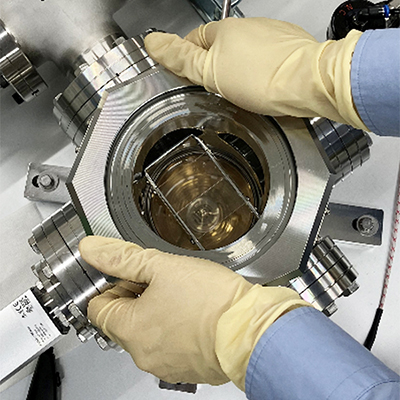
1. “Simple Measurement Operation” Even Beginners Can Perform
Although this device operates under high vacuum, it does not require vacuum transport of samples.
Simply place the sample directly on the quartz stage inside the heating chamber, close the lid, and press the start button to begin measurement.
Stable operation is possible regardless of the operator’s skill level.
2. Signal Shape Preservation and Precise Analysis Enabled by Overwhelming “High-Speed Detection”
This device boasts a detection speed of once per second, which is a full 300 times faster than the detection speed of gas chromatography (atmospheric pressure type), which is only once every few minutes.
With GC methods, it is fundamentally difficult to increase the heating rate because column separation of hydrogen gas takes time.
Consequently, there is a structural limitation whereby the standard heating rate is restricted to approximately 100°C/h.
In contrast, since this instrument, which employs a mass spectrometer, has a detection frequency of approximately once per second, there are no heating rate constraints imposed by detection frequency.
The greatest advantage of this high-frequency sampling is that even when the heating rate is set to a high value, it is possible to obtain the fine, inherent heating desorption signal, ensuring that the “true peak temperature (Tp)” is captured without being missed.
Table: Comparison of Detection Temperature Resolution by Measurement Method
| Detection Interval | ||
| Heating Rate | ESCO-TDS600 IR H2 When measured once per second |
Gas Chromatography Method When measured once every 5 minutes |
| 100°C/h (1.67°C/min) | 0.028°C | 8.3°C |
| 300°C/h (5°C/min) | 0.083°C |
25.0°C |
| 600°C/h (10°C/min) | 0.167°C |
50.0°C |
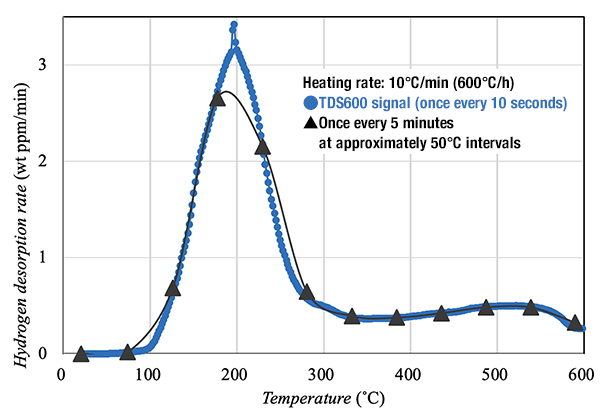 Figure 1
Figure 1: [Comparison] Simulation of missed hydrogen peaks due to differences in detection frequency
As shown in the graph in Figure 1, at a low detection frequency (once every 5 minutes in Figure 1, approximately 50°C intervals), the peak around 196°C is not captured.
The TDS600 is capable of accurately capturing the hydrogen desorption peak.
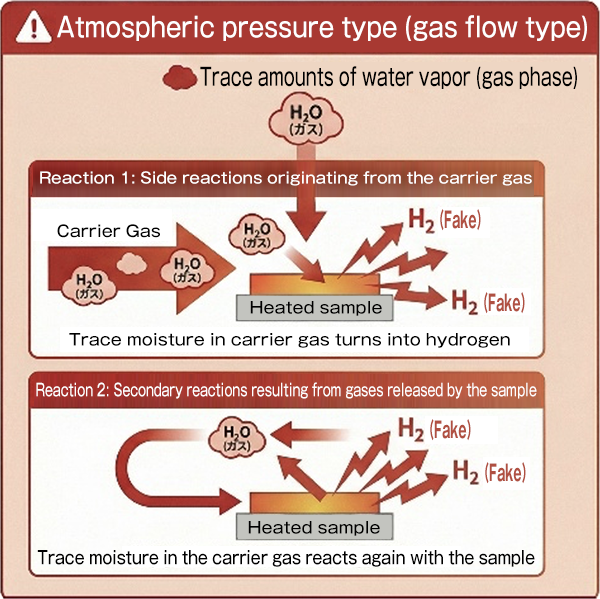 Atmospheric pressure type (gas flow method)
3. “Elimination of Side Reactions” through Ultra-High Vacuum Measurement
In conventional gas flow methods, gases released from the flow gas or the sample may react with the sample, potentially generating “hydrogen not derived from the sample.”
Since this device performs measurements under ultra-high vacuum conditions, it fundamentally eliminates these side reactions and accurately captures only the true amount of hydrogen released.
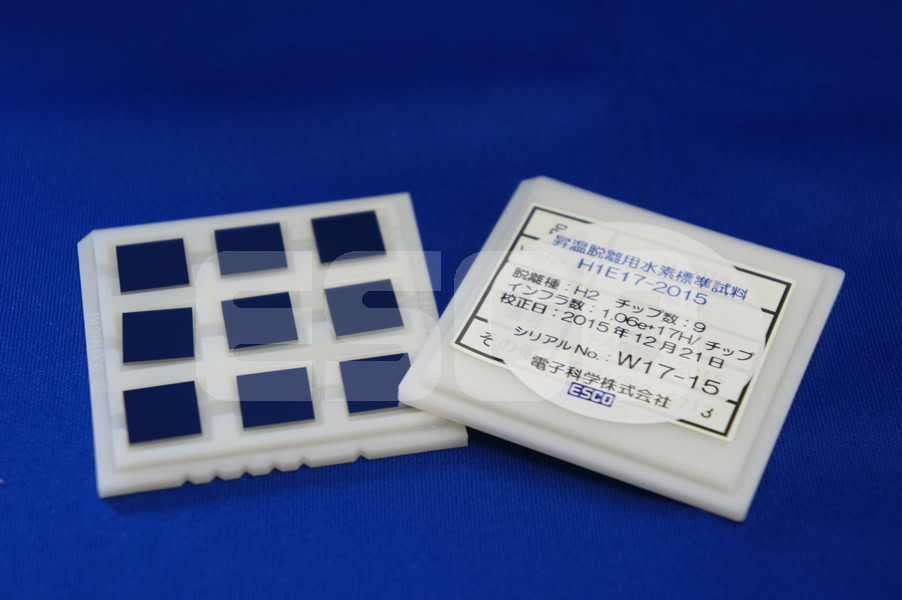 Hydrogen Standard Sample
4. Highly Reliable “Hydrogen Sensitivity Calibration”
The mass spectrometer in this system is calibrated using hydrogen standard samples calibrated with standard leaks recommended by the National Institute of Standards and Technology (NIST).
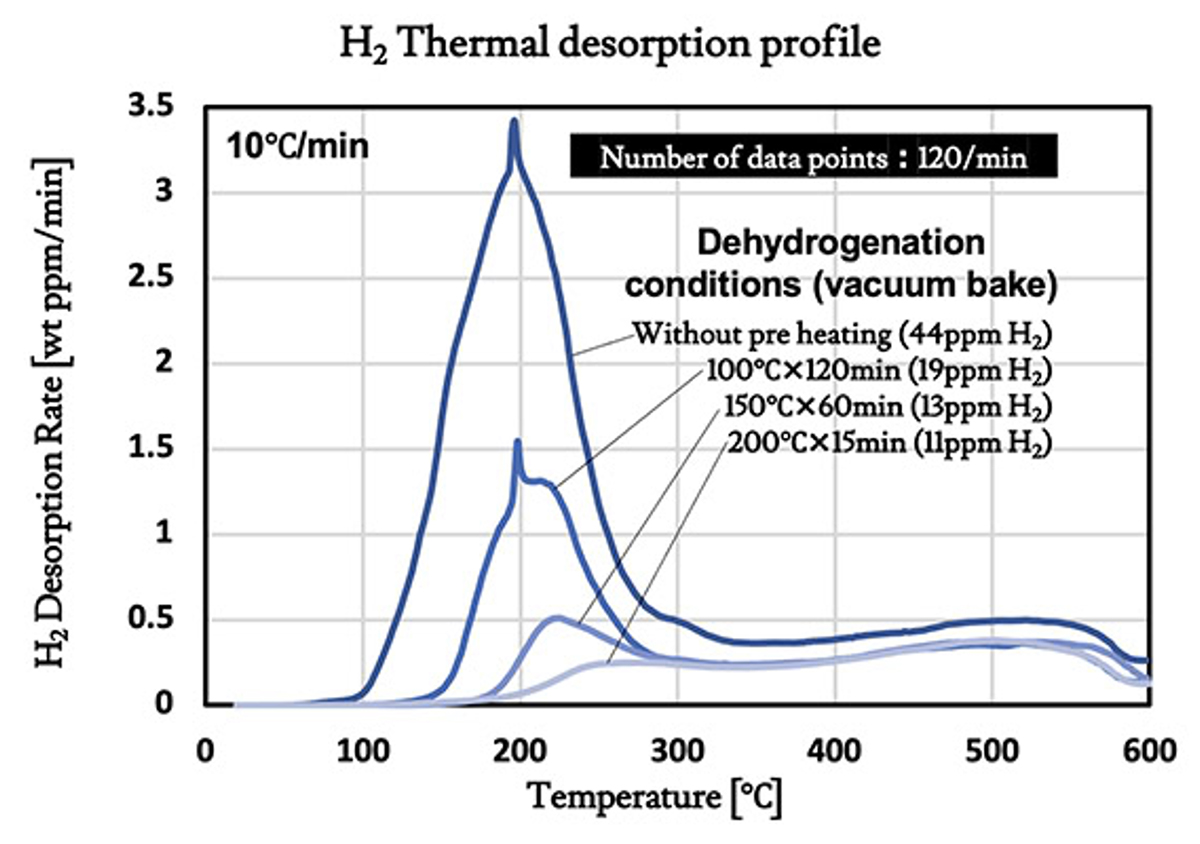 Fig. 2
[ESCO-TDS600 IR H2 Analysis Case Study]
■Hydrogen Analysis and Evaluation of Dehydrogenation Treatment in Electroless Nickel Plating (5 μm)
"This case study measures the behavior of trace hydrogen released from a 5 μm-thick electroless nickel plating layer and compares differences in residual hydrogen levels based on dehydrogenation treatment (baking) conditions.
Fig. 2: Hydrogen thermal desorption profiles of electroless nickel plating (four conditions: no heating, 100°C, 150°C, and 200°C)
[Test Conditions]
• Heating rate: 10°C/min (600°C/h)
• Detection frequency: Once every 0.5 seconds (120 data points/min)
The graph compares hydrogen release profiles under the following four conditions. The numbers in parentheses represent the total amount of hydrogen released during measurement; in other words, they indicate the “amount of hydrogen remaining in the nickel plating film after each dehydrogenation treatment.”
① No dehydrogenation treatment (Residual hydrogen: 44 ppm)
② In a vacuum environment: Heated at 100°C for 120 minutes (Residual hydrogen: 19 ppm)
③ In a vacuum environment: Heated at 150°C for 60 minutes (residual hydrogen: 13 ppm)
④ In a vacuum environment: Heated at 200°C for 15 minutes (residual hydrogen: 11 ppm)
These results indicate that “the higher the processing temperature, the more hydrogen is removed even with a shorter heating time, resulting in a higher dehydrogenation efficiency (less hydrogen remaining in the coating).”
When a fast heating rate of 600°C/h is set, it is difficult to capture the peak of a sharp peak with the low detection frequency typical of conventional gas chromatography methods (e.g., once every 5 minutes = 50°C intervals).
However, in this experiment, by performing measurements at an exceptionally high speed of once every 0.5 seconds, we are able to capture the steep hydrogen release peak from a 5-μm-thick thin film without missing it.
We provide reliable data directly applicable to on-site quality control, such as determining optimal manufacturing processes.
[Basic Specifications: ESCO-TDS600 IR H2]
・Maximum sample size: 30×30×30 mm
・H₂ emission sensitivity: ng/g (ppb)
■Analysis Chamber
・H₂ detector: Mass spectrometer (2–4 Da)
・Pressure Gauge: BA-Pirani combination gauge (Measurement range: 5×10⁻⁸–1×10⁵ Pa)
・Thermometer: Sample stage thermocouple (Type K)
・Chamber: Capacity 10 L, Ultimate vacuum ≤ 1×10⁻⁶ Pa
■ Heating Control
・Temperature Control Range: Room Temperature (RT) to 600°C
・Heating Rate Control Range: 0.5°C/min to 180°C/min
・Number of Heating Steps: Up to 100 steps
・Heat Source: 1 kW halogen lamp
■Software
●Measurement Software
・Real-time monitor: Hydrogen signal intensity (m/z 2–4), measurement time, pressure, temperature
・Configuration functions: Easy configuration of mass spectrometer parameters, setting of heating programs
・Automatic measurement start/stop function: (Control based on MS signal intensity, measurement time, pressure, and temperature)
・Support functions: Sensitivity calibration support
●Data processing software
・Graph Display: Temperature graph, pressure graph, TDS spectrum, mass spectrum
・Background Correction: Minimum value, exponential, spline, file BG
・Data Output: CSV format output (m/z 2, 3, 4 signal intensity, time, pressure, temperature, temperature control output, desorption rate)
