










NEW ESCO-TDS1200Ⅱ IR BGM Thermal Desorption Analyzer with Hand Gap Monitor
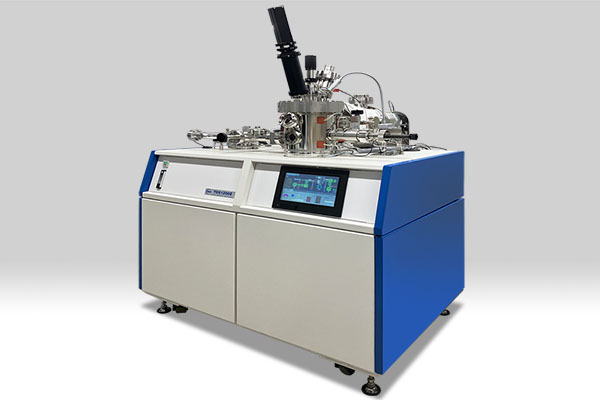 ESCO-TDS1200II IR BGM
A new option for high-speed heating and low-temperature range measurements: direct determination of sample
temperature.
The ESCO-TDS1200II IR BGM is a model equipped with a hand gap monitor, based on the ESCO-TDS1200II IR thermal desorption analyzer, which uses infrared lamp heating.
As before, temperature-programmed desorption analysis is possible over a wide temperature range from room temperature to 1200°C using thermocouple measurements.
In addition, the use of a hand-gap monitor now enables direct optical determination of sample temperature in the range of approximately 75–500°C for samples
containing silicon substrates.
[Basic Performance of the ESCO-TDS1200II IR BGM]
The conventional ESCO-TDS1200II IR employs a design that concentrates infrared lamp light around the sample.
・High-speed heating at 60°C/min
・Short measurement time of approximately 20 minutes per measurement
・Chamber heating minimized by heating the sample center
・Cooling time after heating is approximately 1 to 1.5 hours
The ESCO-TDS1200II IR BGM retains all of these features.
The Hand Gap Monitor is a temperature determination system that utilizes the property of silicon’s hand gap to vary with temperature.

By performing spectral analysis of transmitted light, it directly determines the temperature of samples containing silicon substrates, such as those with thin films formed on the surface of the silicon substrate.
Since the sample temperature can be determined rapidly, temperature control is possible even under rapid heating conditions.
・Infrared lamp heating
・Temperature determination using a hand gap monitor
・Feedback control of lamp power based on temperature information
By combining these features, we expand the options for temperature control in thermal desorption analysis.
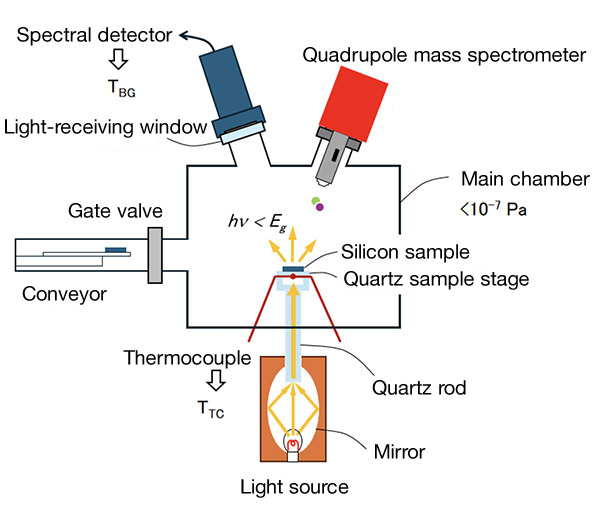 Figure 1
Schematic diagram of a TDS system equipped with a hand-gap monitor (Fig. 1). Broadband white light ranging from visible to near-infrared, emitted from the light source, passes through a high-purity quartz rod and strikes a silicon sample placed on a quartz sample stage inside an ultra-high vacuum chamber. A spectroscopic detector receives a portion of the transmitted light from the silicon through a receiving window.
Application Examples
[1] Evaluation of Water on Oxide Film Surfaces
Measurements using a hand-held gap monitor allow the bonding state of water present on the oxide film surface to be evaluated based on differences in desorption temperatures.
□ Physically adsorbed water that desorbs at low temperatures
□ Stronger-bonded water-related species that desorbs at medium to high temperatures
It is possible to clearly separate and evaluate these based on differences in desorption temperatures.
Therefore, this method is useful for evaluating processes where surface water is critical, such as wafer-level hybrid bonding.
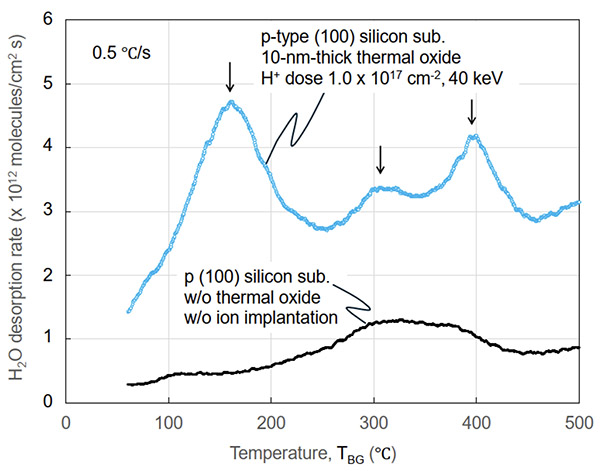 Fig. 2
We prepared a sample by implanting 1.1×10¹⁷ cm⁻² of hydrogen ions at an acceleration energy of 40 keV into a p-type (100) silicon substrate coated with a 10 nm-thick SiO₂ film.
Analysis of the H₂O molecular desorption behavior revealed three desorption peaks near 168°C, 315°C, and 398°C.
The lower-temperature peak is believed to correspond to physically adsorbed water, while the two higher-temperature peaks are thought to correspond to hydroxyl groups and internal water.
This apparatus makes it possible to easily separate the contributions of physically adsorbed water and water more strongly bound to the surface, making it useful for evaluating the H₂O adsorption state on the surface.
(Fig. 2)
[2] Oxide semiconductor thin films (IGZO, etc.)
It allows for the evaluation of the desorption behavior of water-related species and metal components, and can be utilized to investigate heat treatment conditions in thin-film processes.
Summary
The ESCO-TDS1200II IR BGM maintains the high throughput characteristic of conventional instruments while providing a new method for directly determining sample temperature within the range of approximately 75 to 500 °C.
It expands the options for temperature evaluation in thermal desorption analysis, broadening the possibilities for material evaluation and process optimization.
