










Measurement Data Examples
1. Changes Over Time in Hydrogen-Terminated Silicon
Objective & Experimental Procedure
We investigated how silicon wafers whose surfaces were hydrogen-terminated via hydrofluoric acid (HF) treatment change over time when left exposed to an ambient environment.
The hydrogen adsorbed on the surface was thermally desorbed and evaluated using the following sequence:
1. Prepare the hydrogen-terminated Si chips to be utilized in the experiment.
2. Following specimen preparation, conduct thermal desorption experiments on the Si chips after specified elapsed times
(2 days, 7 days, 14 days, and 28 days) at a controlled heating rate of 60°C/min.
3. Compare the resulting desorption signals of the desorbed hydrogen.

Results & Discussion
As demonstrated by the spectral waveforms below, the amount of surface-bonded hydrogen continuously decreases with the passage of time.
Further detailed waveform deconvolution and analysis are required to pinpoint the exact localized states where this reduction occurs.
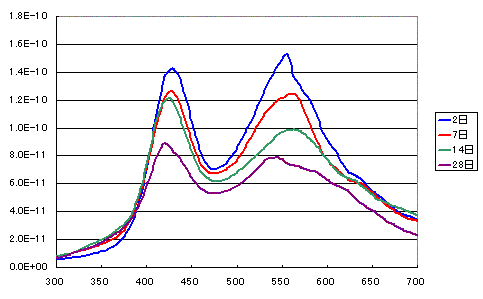
The primary mechanism behind this reduction in surface hydrogen is considered to be progressive surface oxidation and the subsequent growth of a native oxide layer.
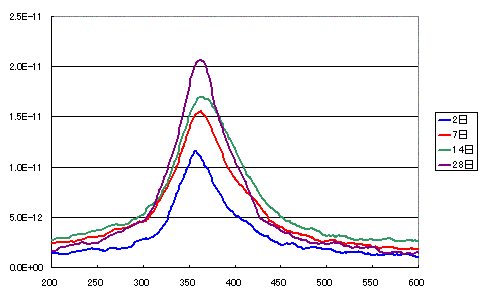
The next set of data illustrates the interaction where surface hydrogen bonds with hydroxyl groups (–OH), resulting in the desorption of moisture (H2O).
As predicted, the absolute volume of desorbed moisture systematically increases over time.
2. Data for Hydrogen Ion-Implanted Specimens
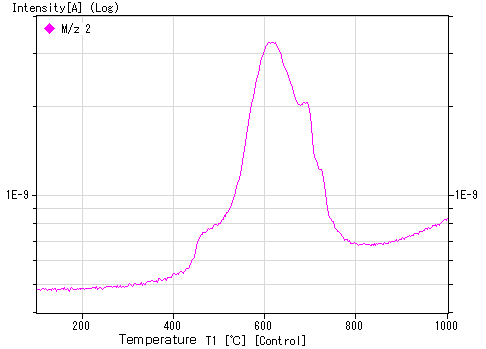
Example of a Hydrogen Ion-Implanted Specimen (1E16 ions/cm²)
Example of a Hydrogen Ion-Implanted Specimen (1E17 ions/cm²)
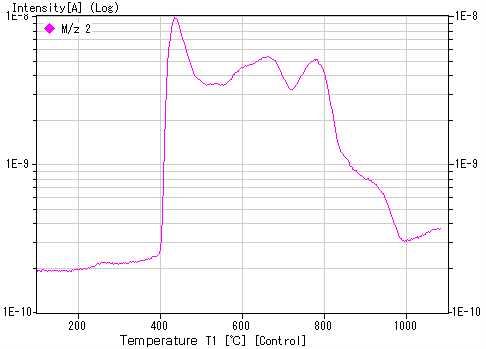
Note: The exact temperatures at which desorption peaks appear are heavily dependent on matrix conditions and specific experimental parameters; therefore, slight variations may occur depending on the instrumentation setup.
3. Reproducibility Data for Hydrogen Ion-Implanted Specimens
Evaluation of a Hydrogen Ion-Implanted Specimen (1E16 ions/cm²)
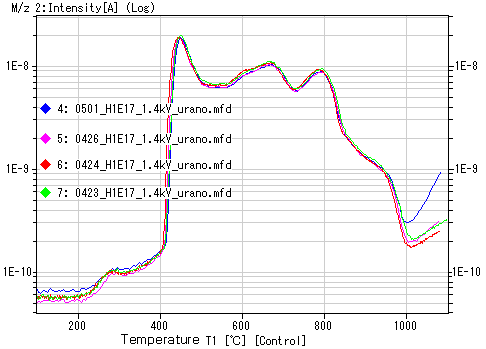
Note: The exact temperatures at which desorption peaks appear are heavily dependent on matrix conditions and specific experimental parameters; therefore, slight variations may occur depending on the instrumentation setup.
4. Data for Argon Ion-Implanted Specimens Coated with Calcium Oxalate
Example of an Argon Ion-Implanted Specimen Coated with Calcium Oxalate (CaC2O4)
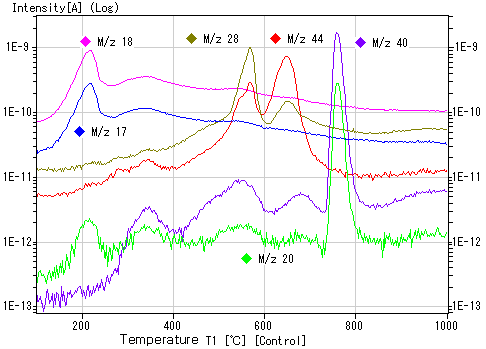
Note: The exact temperatures at which desorption peaks appear are heavily dependent on matrix conditions and specific experimental parameters; therefore, slight variations may occur depending on the instrumentation setup.
5. Diffusible Hydrogen Desorption Characteristics of Hydrogen-Charged Low-Carbon Mild Steel (Low-temperature Thermal Desorption Spectroscopy)
⇒Diffusible Hydrogen Desorption Characteristics of Hydrogen-Charged Low-Carbon Mild Steel (PDF: 170 KB)]

Contact Us
Please feel free to contact us using the form below
for any questions or inquiries regarding our products.
